Have you ever stopped to wonder how a lock actually keeps your home safe? Understanding how front door locks work goes beyond inserting a key — it's about pins, cylinders, engineered tolerances, and increasingly, encrypted wireless signals. The short answer: a well-chosen, properly installed lock can stop most break-in attempts cold. The longer answer is what this guide is for. Whether you're moving into a new place or rethinking your security setup, you'll find everything you need here. For a broader view of protecting your property, explore our home security guides.
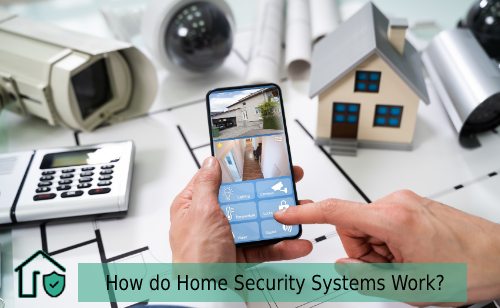
Your front door lock is the most tested piece of security hardware in your home. Burglars test it first. A weak lock — or one that's worn, misaligned, or installed wrong — makes their job easy. A strong, properly maintained one is often enough to make them move on entirely.
This guide covers the mechanics, the main lock types, the smart lock question, and the practical steps you can take today — all in plain language. Let's start with a quick comparison of what's available.
Contents
Types of Front Door Locks at a Glance
Before getting into how front door locks work mechanically, it helps to know what your options are. Not every lock offers the same level of protection. Some are built for security. Others are built for convenience. A few try to do both.
| Lock Type | Security Level | Best For | Key Limitation |
|---|---|---|---|
| Single Cylinder Deadbolt | High | Most front doors | Vulnerable if glass is nearby |
| Double Cylinder Deadbolt | Very High | Doors with glass panels | Slower emergency exit |
| Knob Lock | Low | Interior doors only | Easy to break with tools |
| Lever Handle Lock | Medium | Accessibility-friendly homes | Easier to force open |
| Smart Lock | High | Tech-forward homeowners | Battery dependent |
| Mortise Lock | Very High | Older or high-end homes | Complex to install |
| Rim Lock | Medium | Secondary or apartment doors | Surface-mounted, easier to attack |
For a full breakdown of every category, see this guide on 10 different types of door locks and how they work.
Deadbolts
Deadbolts are the gold standard for front door security. Unlike spring-loaded bolts, a deadbolt can't be compressed or shimmed. It only moves when a key or thumb turn rotates the cylinder.
- Single cylinder: Key outside, thumb turn inside — the most practical everyday choice
- Double cylinder: Key required on both sides — better when your door has glass panes that a burglar could smash to reach the thumb turn
- Look for ANSI Grade 1 (the highest residential standard) and a 1-inch throw bolt minimum
- Brand matters: Schlage, Medeco, and Mul-T-Lock are well-regarded for durability
If you're considering a digital upgrade, our guide to the best smart deadbolt locks covers what separates good options from great ones.
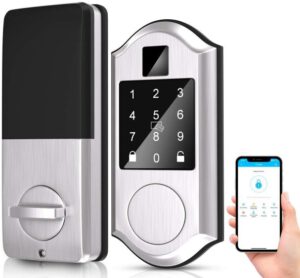
Knob and Lever Locks
Knob locks are everywhere — and widely misused. They're fine for interior doors. On a front door, they're a liability. The cylinder sits inside the knob itself, which means a burglar with pliers can snap it off in seconds. Never use a knob lock as your sole front door security.
Lever handle locks are more accessible — great if you carry groceries or have mobility limitations — but they share similar vulnerabilities. Always pair them with a deadbolt.
Smart Locks
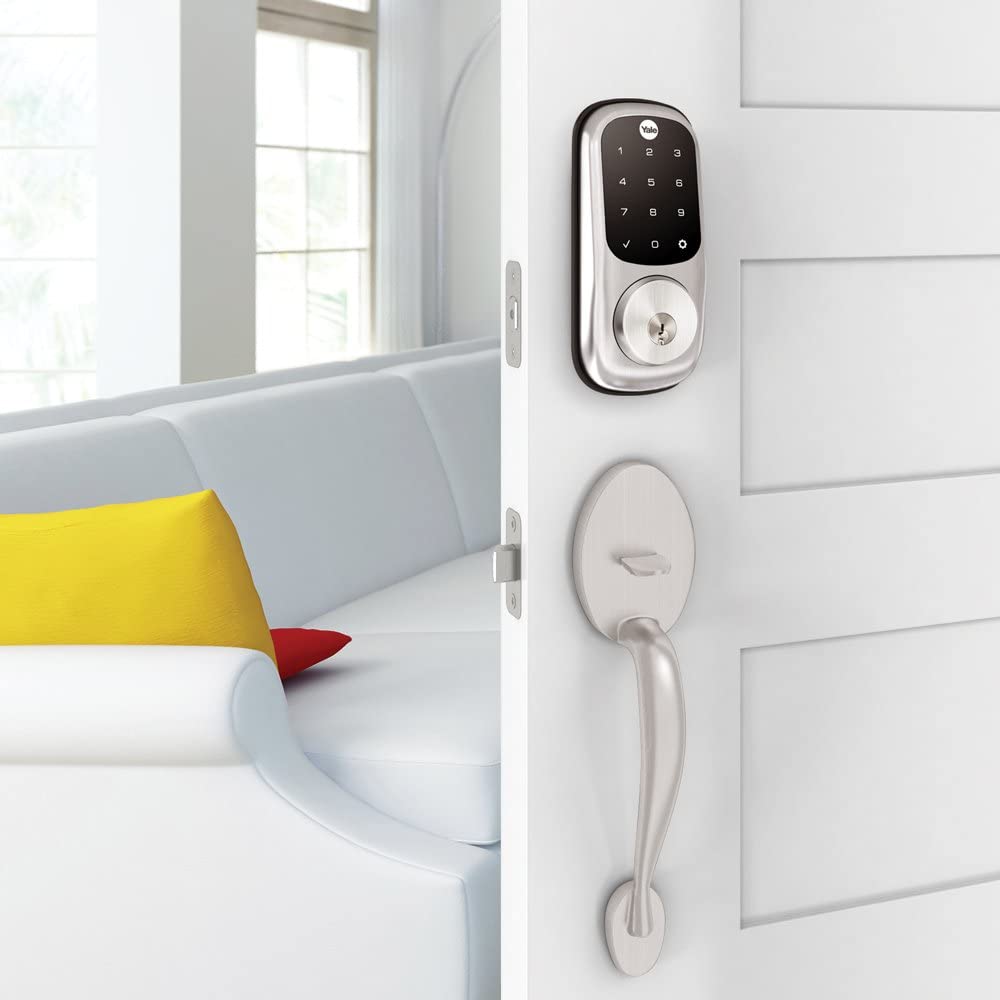
Smart locks replace (or sit on top of) a traditional deadbolt mechanism. Access is granted via PIN pad, fingerprint reader, smartphone app, or proximity detection. Most include a physical key slot as a backup.
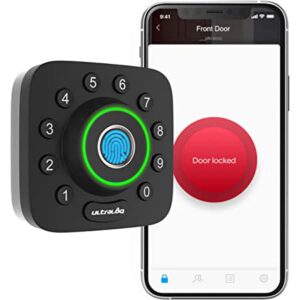
They add convenience and features that traditional locks simply can't match — but they also introduce a power dependency and a digital attack surface worth knowing about.
How Front Door Locks Work: The Mechanics
Here's the part most guides skip. Knowing how front door locks work mechanically helps you evaluate any lock you're considering — and spot a weak one before you buy it.
The Pin Tumbler System
The pin tumbler lock is the mechanism inside the vast majority of residential deadbolts and knob locks. It was patented in the 1860s and is still the dominant design today. Here's how it works, step by step:
- The plug (the cylindrical part your key enters) sits inside a fixed housing called the shell.
- Drilled vertically through the plug are several chambers, each containing two pin segments — a lower "key pin" and an upper "driver pin" — pushed down by a spring.
- When no key is present, the driver pins straddle the gap between plug and shell — called the shear line — preventing the plug from rotating.
- The correct key has cuts that push each key pin to a precise height. When all key pins reach their correct heights, every driver pin lifts entirely above the shear line simultaneously.
- The shear line is now clear. The plug rotates freely and operates the bolt.
- A wrong key leaves one or more driver pins still crossing the shear line. The plug stays locked.
It sounds simple — because it is. The security comes from the precision. Even being off by a fraction of a millimeter keeps the lock closed.
Pro tip: Locks with six or seven pins, plus security pins (spool or serrated shapes), are significantly harder to pick. When buying a deadbolt, look for these features in the spec sheet.
How Deadbolts Extend and Retract
Once the plug rotates, what happens next separates a deadbolt from a spring bolt:
- Spring bolt (knob/lever locks): The bolt has an angled face. Push against it and it compresses. Release and it springs back. This means a credit card or shim can push the bolt back without a key.
- Deadbolt: The bolt is solid and square. It only moves when the plug rotates — either by key or thumb turn. No amount of pushing compresses it. That's why it's called a "dead" bolt.
The deadbolt extends into the door frame's strike plate — a metal plate with a hole for the bolt. This is where most break-ins actually succeed: not the lock itself, but the strike plate pulling out of a weak frame. A heavy-duty strike plate secured with 3-inch screws into the door stud makes a kick-in dramatically harder to execute.
Traditional Locks vs. Smart Locks
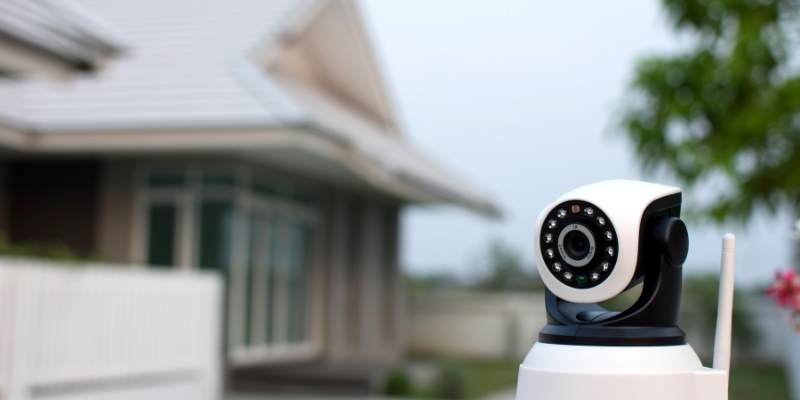
Both types use the same fundamental bolt mechanics. The difference is in how access is controlled and what happens after you turn that metaphorical key.
What Beginners Need
If you're starting from scratch or upgrading from a builder-grade lock, the fundamentals matter most. You don't need anything complex. Focus on these:
- ANSI Grade 1 deadbolt — the highest residential security rating
- At least a 1-inch throw bolt — how far the bolt extends into the frame
- A reinforced strike plate with 3-inch screws — often the weakest link in the whole system
- A solid-core or steel door — a good lock on a hollow-core door offers limited protection
- A reputable brand: Schlage B60N and Medeco are widely trusted starting points
That's your baseline. A Grade 1 deadbolt on a solid door with a proper strike plate will deter the majority of opportunistic break-ins.
Advanced Features for Tech Users
Smart locks add a layer of control and visibility that traditional locks can't match. Here's what you gain:
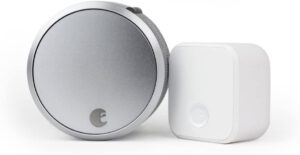
- Remote lock and unlock from anywhere via smartphone
- Temporary access codes for guests, cleaners, or contractors — deletable after use
- Activity logs showing who unlocked the door and exactly when
- Auto-lock by timer or geofencing when you leave the area
- Voice control via Alexa, Google Home, or Apple HomeKit
- Notifications pushed to your phone when the door is opened
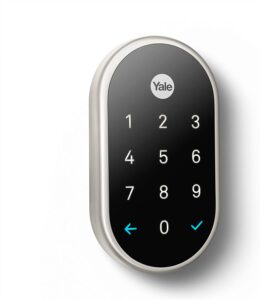
Smart locks aren't a replacement for physical security fundamentals — they're an addition to them. Read our in-depth look at whether smart locks are truly safe before you buy. And for a full explanation of the technology, our guide on how smart locks work is a solid next read.
When to Upgrade Your Front Door Lock
Not every lock needs immediate replacing. Some situations call for action today. Others can wait. Here's how to tell the difference.
Signs You Need a New Lock Now
Act quickly if any of these apply to your situation:
- You just moved in — you have no idea who holds copies of existing keys
- Your lock is stiff, sticky, or the key catches on the way in or out
- The lock is visibly corroded, cracked, or physically damaged
- You've lost a key or given one to someone you no longer trust
- Your only front door lock is a knob lock — replace it immediately
- Someone has attempted to break in, even unsuccessfully — damage may be hidden
- Your current lock is more than 10 years old and has never been serviced
When You Can Hold Off
Sometimes a full replacement isn't the right first move:
- Your Grade 1 deadbolt is under five years old, functions smoothly, and has no damage
- You only need to invalidate old keys — a locksmith can rekey your existing lock for $20–$50, which is far cheaper than replacing it
- Your door frame is the weak point, not the lock — reinforce the frame first before spending money on a new lock
- You're renting — talk to your landlord before making changes, and know your rights in your area
Rekeying is consistently underused. It renders every existing key useless and costs a fraction of a new lock. If you've just moved in, it should be your first call.
Lock Mistakes That Put Your Home at Risk
Understanding how front door locks work also means understanding how people accidentally undermine them. These mistakes show up constantly — and they're all avoidable.
Installation Errors
- Using short screws on the strike plate — the single most common mistake. Short screws anchor only into the door jamb trim, which splits in one kick. Use 3-inch screws that reach the stud behind the trim.
- Installing the lock on a hollow-core door — the door itself will fail before the lock does. Hollow-core doors are for interior rooms.
- Misaligning the bolt — the bolt doesn't fully engage the strike plate hole, reducing hold strength by half or more.
- Skipping the deadbolt and relying only on the knob lock that came with the door.
- Not testing the lock after installation — always cycle it a dozen times before closing up the door.
Usage Habits That Weaken Security
Warning: A deadbolt turned only halfway — or a door that appears closed but isn't fully latched — offers almost no protection. Always check that the bolt is fully extended before walking away.
- Leaving a spare key under the doormat, above the door frame, or in a fake rock near the entry — burglars check these spots first
- Sharing PIN codes or app access with too many people, then never rotating them
- Ignoring a lock that's getting stiff or harder to operate — it's telling you something is wrong
- Using only the knob lock at night because the deadbolt feels like extra effort
- Assuming a chain or security bar replaces a working deadbolt — they don't
Keep Your Lock in Top Shape
A maintained lock lasts 20 years or more. A neglected one fails when you need it most. The maintenance routine is simple — and you only need to do it twice a year.
Cleaning and Lubrication
- Blow out the keyhole with a can of compressed air to clear dust, grit, and debris.
- Wipe down the exterior lock body with a dry cloth. Avoid water and household cleaners — they can corrode internal components.
- Apply a dry graphite lubricant or PTFE (Teflon) spray into the keyway. Avoid WD-40 — it's a solvent, not a lubricant, and it attracts grime that will clog pin chambers over time.
- Insert your key and cycle it several times to distribute the lubricant throughout the pin chambers.
- Check and tighten the strike plate screws — they loosen over time from repeated use and seasonal door shifting.
- Test the deadbolt: it should extend and retract smoothly with no catching, grinding, or resistance.
For smart locks, add a monthly battery check to your routine. Most models alert you when batteries are low, but don't wait until you're standing outside at midnight.
If your lock is beyond maintenance and needs a full swap, our step-by-step guide on how to replace a front door lock with a keyed deadbolt walks you through the whole process without needing to call a professional.
When to Call a Locksmith
Some problems are beyond a routine fix. Call a licensed locksmith when:
- The cylinder spins freely but the bolt doesn't move — a sign of internal mechanism failure
- Your key breaks off inside the lock — don't try to dig it out yourself with metal tools
- The door frame has shifted significantly and the bolt no longer aligns with the strike plate
- You're locked out with no spare key available
- The lock passed a break-in attempt but feels different afterward — internal damage isn't always visible
A licensed locksmith can rekey, repair, or replace most locks in under an hour. Forcing a damaged lock typically causes more damage and may void any manufacturer warranty.
Quick Security Wins for Your Front Door
You don't need to spend much to significantly improve your front door security. These are the highest-impact changes, ranked roughly by value.
Hardware Upgrades
- Upgrade your strike plate to a heavy-duty steel model with 3-inch screws — this single change is the most cost-effective security improvement you can make
- Install a door reinforcement kit (also called door frame armor) around the frame to prevent the jamb from splitting on impact
- Add a Grade 1 deadbolt if you don't have one — this is non-negotiable on a front door
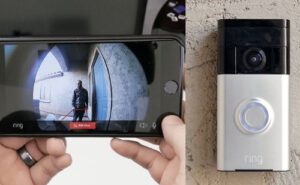
- Mount a video doorbell so you can see and speak to visitors before opening the door — it also deters package theft and scam callers
- Add motion-activated lighting at your entry — well-lit doors are significantly less attractive to intruders
- Consider a door viewer (peephole) with a wide angle if you don't have a video doorbell
Behavioral Changes That Cost Nothing
- Always engage the deadbolt — not just the knob — every single time you leave, even for a few minutes
- Never hide a spare key outside. Use a key lockbox mounted out of sight, or leave a spare with a trusted neighbor.
- If you use a smart lock, review your access log monthly and delete unused codes
- Enable two-factor authentication on your smart lock app — adds a verification step if your phone is lost or stolen
- Get in the habit of testing your lock before bed each night — just a quick turn of the thumb to confirm it's engaged
Small habits stack up. Consistent use of your deadbolt matters more than any gadget you could buy.
Final Thoughts
You now understand how front door locks work — from the precision engineering of a pin tumbler cylinder to the encrypted signals of a modern smart lock. Your next step is a simple one: walk to your front door right now, test your deadbolt, and honestly assess whether it meets the standards you've just read about. If it doesn't, start with a Grade 1 deadbolt and a reinforced strike plate — that one upgrade alone will put your home in a significantly stronger position than most of your neighbors.


About Vincent Foster
Greetings, This is Tom Vincent. I’m a home Security Expert and Web developer. I am a fan of technology, home security, entrepreneurship, and DIY. I’m also interested in web development and gardening. I always try to share my experience with my reader. Stay Connected and Keep Reading My Blog. Follow Me: Facebook, Twitter, Pinterest
Now you can get FREE Gifts. Or latest Free Security Cameras here.
Disable Ad block to reveal all the gifts. Once done, hit a button below