If you need to know how to open a master lock without combination, put down the bolt cutters. Most standard Master Lock padlocks respond to several practical techniques that preserve the lock and cost nothing. You have real options here, and the right one depends on how much time you have and which model you're dealing with. For a broader look at lock security and bypass techniques, browse SecureOne's lock guides.
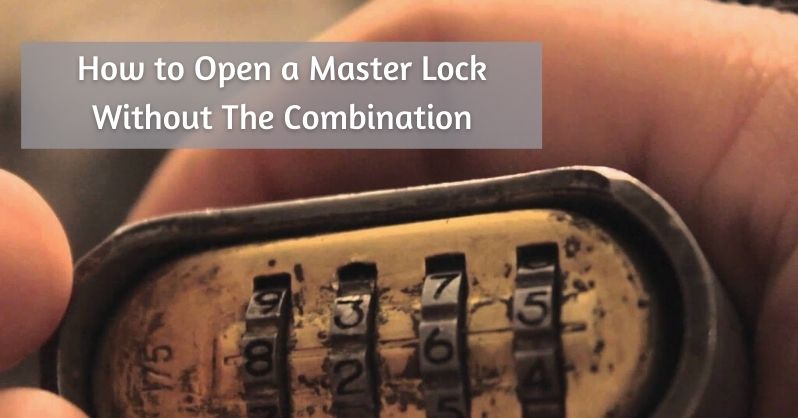
These methods apply only to locks you own or have legal authorization to open. That's a firm line. Opening someone else's padlock without permission is illegal in virtually every US state. But if you set this combination yourself and forgot it, inherited a locked storage unit, or bought a secondhand lock with no combination attached, you're in exactly the right place. This guide is about getting back into your own property, cleanly and efficiently.
Master Lock combination padlocks are everywhere — school lockers, storage units, gym bags, gates, and bike racks. Their popularity comes from an affordable, key-free design. But that same simplicity creates predictable weaknesses you can use to your advantage. Understanding how the internal mechanism works is the fastest route to opening it without the combination.
Contents
- How Master Lock Combination Padlocks Actually Work
- The Fastest Ways to Open a Master Lock Without the Combination
- Advanced Techniques for Opening a Stubborn Master Lock
- Comparing All Your Options at a Glance
- DIY vs. Hiring a Locksmith — Honest Pros and Cons
- What Getting Back In Actually Costs
- Key Takeaways
How Master Lock Combination Padlocks Actually Work
The Three-Disc Mechanism
A standard combination padlock contains three rotating discs — called cams or rotors — stacked on a central spindle inside the lock body. Each disc has a notch cut into its edge. When you dial your combination correctly, all three notches line up at the same point. A small metal locking bar drops into that aligned gap, and the shackle snaps open.
Turning the dial clockwise on your first pass engages all three discs simultaneously. Switching to counterclockwise drops one disc and continues driving the remaining two. A final clockwise turn drops the second disc and moves only the third into position. That precise sequence is what makes the combination work — but it's not as rigid as most people assume.
The Tolerance Factor That Works in Your Favor
Mass-produced locks are built with small manufacturing tolerances. Each correct number on a Master Lock doesn't need to be dialed to an exact digit — there's a window of one to two numbers on either side of each true position. Master Lock builds this in deliberately, so casual users don't have to dial with surgical precision. The side effect is that the discs give off subtle physical signals — resistance, hesitation, a faint catch — that reveal where each true number sits. Every non-destructive method in this guide exploits that signal. You're not cracking the lock; you're reading it.
The Fastest Ways to Open a Master Lock Without the Combination
The Pull-and-Turn Method
This is where you start. No tools, no cost, works on most standard consumer-grade padlocks. Pull up firmly on the shackle with your non-dominant hand. Apply steady upward tension — not a yank, just constant firm pressure. While holding that tension, rotate the dial clockwise slowly, one number at a time. At certain positions the dial resists. It doesn't stop completely; it just gets noticeably harder to move. Those are your resistance points. Stop at each one and write the number down.
Complete at least two full rotations to confirm your readings. You'll typically land on twelve resistance points across the dial. The real combination candidates separate from the false ones by parity — if the false points cluster at even numbers, the true ones fall at odd, and vice versa. Filtering that way usually cuts your list from twelve down to three or four candidates per disc position. With three real candidates per number, you have at most 27 combinations to test. That's typically fifteen to twenty minutes of methodical work — well worth the effort before you consider anything destructive.
The Reset Trick
If you set the combination yourself, some Master Lock models ship with a small reset tool — a pin that inserts into a slot on the bottom of the lock body. With the shackle open, insert the pin, spin the dials to a new combination of your choice, remove the pin, and the lock is reset. This approach takes under a minute if you have the tool. If you can't find it, the pull-and-turn or decoding methods are your next move.
Pro tip: Master Lock runs a lost combination lookup service on their website — submit the serial number stamped on the back of the lock body along with proof of ownership, and they'll provide your combination directly. It takes a few business days, but it's free and completely legitimate.
Advanced Techniques for Opening a Stubborn Master Lock
Decoding the Combination by Feel
When the pull-and-turn method narrows down your candidates but doesn't pin them exactly, decoding by feel takes over. This approach is slower but reliable on most standard padlocks.
Apply light upward tension on the shackle. Rotate the dial clockwise slowly, pausing at each number. You're listening and feeling for a faint hesitation — a position where the dial catches for a fraction of a second before continuing. That catch, confirmed across two or three slow passes at the same number, is a disc engaging. Your goal is to find the third disc's true position first, since it's the most responsive to light tension.
Once you have a confirmed candidate for the third number, release the tension, reset the dial with a few full spins, and rotate counterclockwise to identify the second number. Repeat the process one more time clockwise for the first number. Keep a notepad nearby and write every confirmed candidate down as you go — your working memory will fail you faster than the lock will. With three solid candidates for each position, you're testing at most 27 combinations. Work through them systematically and you'll be in within thirty minutes.
Shimming the Shackle
Shimming works on padlocks where the shackle is held in place by a spring-loaded latch rather than a solid locking bar. Many entry-level Master Lock models fall into this category. You need two small aluminum shims — a section cut from a soda can works perfectly. Cut two pieces roughly one inch by one and a half inches. Fold each piece into a U-shape and cut a small notch into the fold. Slide one shim onto each side of the shackle, between the shackle and the lock body, and press down firmly while pressing the shackle down toward the lock body at the same time.
This method doesn't work on double-locking models, which have anti-shimming pins embedded on both sides of the shackle. If the lock doesn't respond after three or four careful attempts, you're dealing with a double-locked model and shimming won't help. The same shim technique applies to other hasp-style locks — if you've ever worked through picking a mailbox lock without a key, the physical motion is nearly identical.
Contacting Master Lock Directly
If you own the lock, have the serial number (stamped on the back of the lock body), and can provide basic proof of ownership, Master Lock will give you your combination. Submit a request through their website, attach documentation, and they respond within a few business days. No tools, no technique, no guesswork. This is the cleanest path available if you can afford to wait and you have the paperwork. It's worth checking the back of the lock for that serial number before trying anything else — if it's there, this option is open to you.
Comparing All Your Options at a Glance
Not every method suits every situation. Here's an honest breakdown so you can pick the right approach before spending time or money on the wrong one.
| Method | Time Required | Tools Needed | Success Rate | Destroys Lock? |
|---|---|---|---|---|
| Pull-and-turn decoding | 10–20 min | None | Moderate | No |
| Reset tool | Under 1 min | Reset pin (included with lock) | High (if tool on hand) | No |
| Master Lock lookup service | 2–3 business days | Serial number + proof of ownership | Very high | No |
| Decoding by feel | 15–30 min | None | Moderate to high | No |
| Shim method | 2–5 min | Aluminum can + scissors | Moderate (single-lock models only) | No |
| Locksmith | 30–60 min | N/A | Very high | Possible |
| Bolt cutters | Under 1 min | Bolt cutters | Very high | Yes |
Matching the Method to Your Situation
No tools available and you need access now? Start with pull-and-turn or decoding by feel. Have an aluminum can nearby? Try shimming first if your model looks like a basic padlock. Can you wait a couple of days and have the serial number? The Master Lock lookup service is your smartest move — free, accurate, no risk of damaging anything. When the lock is protecting high-value property and none of the above is moving it, call a locksmith rather than force it.
The same decision framework applies across other types of secure storage. If you've ever been locked out of a gun safe in an emergency, the logic is identical — see how it plays out in the guide on opening a gun safe without a key.
DIY vs. Hiring a Locksmith — Honest Pros and Cons
The Case for DIY
DIY makes sense when the lock is a standard consumer-grade padlock, you have twenty to thirty minutes to spend, and the stakes aren't time-sensitive. The pull-and-turn and decoding methods require zero experience. The shim method needs nothing more than a soda can and scissors. None of these techniques damage the lock if you do them correctly, so the downside is minimal.
DIY also wins on pure economics when the lock is cheap. A basic Master Lock combination padlock costs $8–$15 at any hardware store. If you've tried the techniques and the lock isn't responding, cutting it and replacing it is often the most efficient outcome. You're not saving a $200 deadbolt — you're deciding whether another thirty minutes of effort is worth more than a $12 replacement. Be honest with yourself about that trade-off.
When to Call a Professional
Call a locksmith when the lock is guarding something valuable, when you've already spent significant time without progress, or when the model is a higher-security version with anti-pick features. Locksmiths carry tension bars, pick guns, and decoder tools that make short work of even upgraded padlocks. A standard service call runs $65–$150 during business hours and $150–$250 after hours or on weekends.
Don't wait until you've burned through every DIY option before calling. If the lock is on a business gate, a storage unit with significant property inside, or any access point where delay has real cost, the locksmith fee is trivial compared to what you're protecting. Make that call early if the situation warrants it.
What Getting Back In Actually Costs
Free Options First
Three of the most reliable methods in this guide cost nothing at all. The pull-and-turn technique, decoding by feel, and the Master Lock lost combination service are entirely free. Even the shim method is effectively free if you have an aluminum beverage can in the recycling. Before you spend a single dollar, exhaust these options. Most people who end up cutting a lock open never tried the decoding methods — not because they don't work, but because they didn't know about them.
The Paid Scenarios
When you move to paid options, two costs dominate. The first is lock replacement: $8–$25 for a new Master Lock padlock depending on security rating. This is often the best resolution when the lock is cheap and your time is valuable — cut it, replace it, pick a combination you'll actually remember, and move on.
The second cost is a locksmith. Standard padlock work typically lands at the lower end of the service range, around $65–$100, especially for common consumer models. After-hours calls can double or triple that number. Some locksmiths offer flat-rate pricing for simple padlock jobs — always ask for a quote before authorizing anything.
There's also an invisible cost worth naming: your time. If you spend two hours on DIY attempts before finally calling a locksmith, your total cost is the locksmith fee plus whatever two hours of your time is worth. If the lock guards something important, calling a professional early often saves money in the long run. Factor your own hourly value into the decision before you start spinning the dial for the hundredth time.
Key Takeaways
- The pull-and-turn decoding method and decoding by feel are your best free first attempts — both work on most standard Master Lock padlocks with no tools required.
- The Master Lock lost combination service is the most reliable and legitimate option if you own the lock and have the serial number; it's free and takes only a few business days.
- The shim method works only on single-locking padlock models — double-locked versions have anti-shimming pins that block this approach entirely.
- When DIY isn't working and the property is valuable, a $65–$150 locksmith call is almost always cheaper than forcing the lock or damaging what it protects.


About Vincent Foster
Greetings, This is Tom Vincent. I’m a home Security Expert and Web developer. I am a fan of technology, home security, entrepreneurship, and DIY. I’m also interested in web development and gardening. I always try to share my experience with my reader. Stay Connected and Keep Reading My Blog. Follow Me: Facebook, Twitter, Pinterest
Now you can get FREE Gifts. Or latest Free Security Cameras here.
Disable Ad block to reveal all the gifts. Once done, hit a button below