Over 10% of self-storage renters report theft or break-in attempts at their units each year — and in most cases, a cheap padlock was the only thing standing between a thief and everything inside. Picking the right padlock for your storage unit is not a minor decision. The lock you choose determines whether a bolt cutter, a drill, or a simple pick can defeat your security in under 30 seconds.
In 2026, the market for storage-grade padlocks is more competitive than ever. You'll find everything from affordable laminated steel options under $20 to Swiss-engineered disc locks that cost over $100. The difference between them is not just price — it's the difference between a lock that stops a determined thief and one that only slows them down for a few extra seconds.
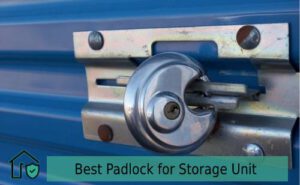
This guide covers the 10 best padlocks for storage units in 2026, tested and evaluated across key criteria: cut resistance, drill resistance, pick resistance, weather protection, and ease of use. Whether you're locking up a 5×5 climate-controlled unit or a large outdoor drive-up bay, there's a lock on this list that fits your security needs and budget. We've done the research so you don't have to guess at the hardware store. If you're also thinking about pairing your lock with a camera system, check out our camera reviews for complementary surveillance options.

Best Choices for 2026
- #PreviewProductRating
- Bestseller No. 1
 Rating:

- Bestseller No. 2
 Rating:
 - Bestseller No. 3
 Rating:
 - Bestseller No. 4
 Rating:
 - Bestseller No. 5
 Rating:
 - Bestseller No. 6
 Rating:
 - Bestseller No. 7
 Rating:

Our Hands-On Reviews
1. ABUS Diskus 20/70 Padlock — Best Overall
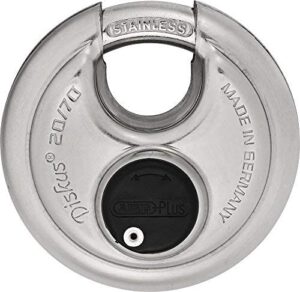
The ABUS Diskus 20/70 is the padlock that security professionals recommend most often for storage units — and it earns that reputation. At 2.75 inches wide and just over an inch deep, the disc-style body presents virtually no exposed shackle for bolt cutters to grip. That's the defining feature of the Diskus design: the shackle is recessed inside the steel body, making shackle-cutting attacks extremely difficult. The lock body itself is constructed from hardened stainless steel with corrosion-resistant coating, so outdoor exposure doesn't degrade it over time.
The cylinder uses a 5-pin tumbler system and the lock comes with 2 keyed-different keys, meaning your keys won't open your neighbor's unit. This is the key-retaining design, which requires the key to lock the shackle — you can't walk away from an open unit by accident. At 2.75" wide and with a 5mm shackle diameter, it fits the standard hasp on most self-storage roll-up doors without any adapter. The build quality is exactly what you'd expect from ABUS, a German manufacturer with over 95 years in the security hardware business.
If you're only buying one lock for your storage unit in 2026, this is it. It covers the most common attack vectors — bolt cutters, rust degradation, and accidental unlocking — in a single, affordable package. The disc body profile also resists prying significantly better than traditional open-shackle padlocks.
Pros:
- Recessed shackle design defeats bolt-cutter attacks
- Hardened stainless steel body resists cutting, drilling, and rust
- Key-retaining mechanism prevents accidental open storage
- Fits standard storage unit hasps without modification
- Keyed-different for individual security
Cons:
- Shackle clearance (0.63" horizontal, 0.67" vertical) is tight for non-standard hasps
- Only a 5mm shackle — adequate but not maximum diameter for the price tier

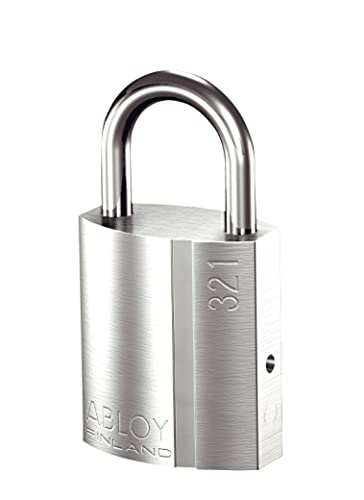
2. Abloy Protec2 PL 321 Padlock — Best Premium Security
The Abloy Protec2 PL 321 is the gold standard for high-security padlocks. This Finnish-engineered lock uses a rotating disc mechanism instead of pin tumblers — a fundamentally different system that eliminates the vulnerability to picking that affects virtually every other padlock on this list. The Abloy Protec2 system has never been successfully picked in standard conditions, making it the preferred choice for law enforcement, military facilities, and anyone storing genuinely irreplaceable items. Single-piece stainless steel construction means there are no seams or joints for pry attacks to exploit.
The touch control mechanism feels smooth and precise, with none of the grittiness you get with budget locks after a year of outdoor exposure. The sleek, modern design is a bonus — this lock looks as serious as it performs. Key duplication requires Abloy's authorized dealer network and the original key card, so your key cannot be copied at a hardware store without your knowledge. That alone makes this lock relevant for shared-access situations where key control matters.
The price point is significantly higher than anything else on this list. If your storage unit holds high-value tools, irreplaceable documents, business inventory, or collectibles worth thousands, the Abloy Protec2 is worth every dollar. For a standard household storage unit, the ABUS Diskus offers 90% of the protection at a fraction of the cost. Know what you're protecting before you commit.
Pros:
- Rotating disc cylinder — essentially unpickable by conventional methods
- Single-piece stainless steel construction with no weak seams
- Restricted key duplication via authorized dealers only
- Exceptional corrosion and drill resistance
- Touch control mechanism stays smooth after years of use
Cons:
- Significantly more expensive than any other option on this list
- Replacement keys require visiting an authorized Abloy dealer
3. Master Lock 930DLHPF — Best Value
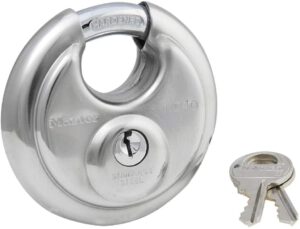
Master Lock has been the default padlock brand in North America for decades, and the 930DLHPF shows why the company still earns that trust at the value end of the market. The boron alloy shackle is the standout specification here — boron steel is significantly harder than standard steel alloys, giving it cut resistance that punches well above the price point. The solid steel body rounds out the package with a lock that performs reliably for years of storage use without requiring any maintenance.
The 5-pin removable cylinder is particularly useful if you're managing multiple units or want to rekey the lock later without buying a new one entirely. Pick resistance is solid for the price tier — certainly not Abloy-level, but well above what most storage unit thieves bother to defeat. If you want to understand the techniques that lock cylinders need to resist, the guide on how to pick a deadbolt lock explains the mechanics well, and the same principles apply to padlock cylinders.
This is the right choice if you're on a budget, stocking multiple storage units, or just want a reliable everyday lock without overthinking it. It covers gate, shed, and storage applications equally well. It's not the most impressive lock on this list, but it's honest about what it is: a well-made, affordable, dependable padlock for everyday use.
Pros:
- Boron alloy shackle delivers strong cut resistance at a low price
- 5-pin removable cylinder is rekeyable
- Solid steel body handles indoor and outdoor exposure
- Trusted brand with broad availability and replacement key support
Cons:
- Open shackle design is more vulnerable to bolt cutters than disc locks
- Pick resistance is moderate compared to premium options
- Less corrosion-resistant finish than ABUS stainless offerings
4. Abus 83/55 Rock Hardened Steel Padlock — Best Close-Shackle
The Abus 83/55 "Rock" is a close-shackle padlock built for applications where a disc lock won't fit but you still want maximum shackle protection. At 55mm wide and 91.5mm tall, the body is substantial. The close-shackle design means the shackle barely protrudes above the body — making it nearly impossible to get bolt cutter jaws around the shackle for a clean cut. This is the architecture you want when you're securing a hasp or staple that doesn't accept a disc lock profile.
ABUS built the 83/55 with hardened steel throughout — body, shackle, and cylinder housing. The depth of 25mm keeps the profile slim and practical for most standard storage hardware. The cylinder is pick-resistant and the overall build reflects ABUS's commercial-grade standards. This lock won't look as slick as the Diskus, but it performs at the same tier for close-shackle applications where the Diskus simply can't fit.
This is the right call for drive-up storage units with older hardware, cargo containers, or any application where the gap between door and hasp is too narrow for a disc-style lock. Check your hasp dimensions before ordering — the 55mm body width and 91.5mm height need to clear your specific hardware.
Pros:
- Close-shackle design defeats bolt-cutter attacks effectively
- Hardened steel body and shackle resist cutting and drilling
- Compact 25mm depth fits tight hasp clearances
- Commercial-grade construction from ABUS
Cons:
- Tall profile (91.5mm) won't suit all storage unit door hardware
- Fewer features than ABUS Diskus at a comparable price point
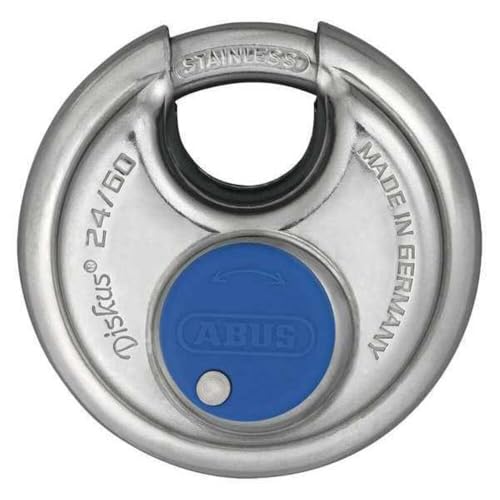
5. ABUS 24IB/60 Diskus Padlock — Best for Outdoor & Marine
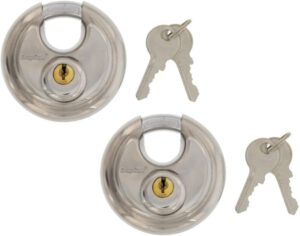
The ABUS 24IB/60 takes the core Diskus architecture and optimizes it specifically for environments where weather is a serious concern. The "IB" designation stands for "Edelstahl" (stainless steel in German) — every external surface, including the shackle, uses marine-grade stainless steel construction that resists salt air, humidity, rain, and freeze-thaw cycles better than any other lock in this price range. If your storage unit is outdoor drive-up, beachside, or boat storage, this is the only disc lock you should consider.
At 2.36 inches wide and with a 0.31-inch shackle diameter — slightly thicker than the 20/70's 5mm — the 24IB/60 offers comparable bolt-cutter resistance within the disc form factor. It comes with 2 keys, uses key-retaining operation, and fits most standard storage unit hasps. The 17mm horizontal clearance and 13.1mm vertical clearance handle most standard hardware without issue, though you should measure your hasp before ordering if you're working with non-standard equipment.
If you store a trailer, boat equipment, or anything in an outdoor facility that sees real weather, the 24IB/60 justifies its price over the standard 20/70. For climate-controlled indoor units, the 20/70 is sufficient and costs less.
Pros:
- Marine-grade stainless steel construction — fully weatherproof
- Disc body design eliminates exposed shackle bolt-cutter risk
- Slightly thicker shackle (7.94mm) than the standard 20/70
- Key-retaining design prevents accidental open storage
- Certified for outdoor, marine, and storage applications
Cons:
- Smaller clearance (13.1mm vertical) than the 20/70 — won't fit all hasps
- Premium weather-resistant finish adds cost over base Diskus model
6. ABUS 37/70 RK Granit Alloy Steel Padlock — Best Anti-Drill Protection
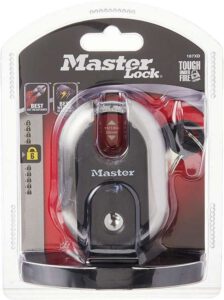
The ABUS Granit series is built for adversaries who bring power tools. The 37/70 RK's tensile resistance exceeds 6 tons — that's the force required to physically pull the shackle free of the body, a brute-force attack technique that defeats many padlocks that resist cutting. The black Granit coating over hardened alloy steel gives the body and shackle exceptional corrosion resistance alongside the drill-resistant disc cylinder that ABUS uses across their ABUS Plus line.
The anti-drill protection in the cylinder housing is genuine. ABUS uses hardened steel inserts in the cylinder housing specifically to defeat angle grinder and drill attacks, which are the most common tool-assisted attacks on storage unit locks in 2026. The lock includes 2 keys plus an anti-key-duplication card — meaning key copies can only be made at authorized ABUS dealers, not at hardware stores or kiosks. That matters if you share access or if key control is a concern. Understanding how picking techniques work helps you appreciate what a quality cylinder actually defends against — the how to pick a file cabinet lock guide demonstrates the mechanics of pin tumbler vulnerabilities in practical terms.
The 37/70 RK is the best option on this list for storage units in high-risk facilities — commercial warehousing, urban storage centers with higher theft rates, or any location where you have reason to believe power-tool attacks are a real possibility. It's heavier and slightly bulkier than the disc locks, but that bulk represents genuine structural resistance.
Pros:
- Over 6-ton tensile resistance — defeats shackle-pull attacks
- ABUS Plus disc cylinder is drill-resistant and pick-resistant
- Hardened alloy steel with Granit corrosion-resistant coating
- Anti-key-duplication card restricts unauthorized key copying
- Includes 2 keys
Cons:
- Open shackle design (vs. disc locks) has more exposed shackle area
- Heavier and bulkier than disc-style options
- Higher price point than the ABUS Diskus series
7. BRINKS 50mm Commercial Laminated Steel Padlock — Best Laminated Steel
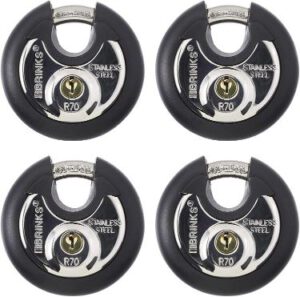
Brinks built a strong reputation in commercial-grade security before pivoting to consumer products, and the 50mm laminated steel padlock reflects that heritage. Laminated steel construction — multiple layers of hardened steel plates bonded together — gives the body exceptional resistance to impact attacks like hammer strikes that can crack or deform solid steel bodies over time. The TPE elastomeric full-body cover protects against weather and impact while giving you a comfortable grip in wet conditions.
The boron steel shackle delivers a rated cut strength up to 10,000 lbs, which is genuinely impressive for this price tier. The stainless steel ball-bearing locking mechanism provides smooth, reliable operation in all weather conditions, and the five-pin pick-resistant tumbler cylinder handles standard picking attempts effectively. This is not a disc lock, so the shackle is exposed — but the boron construction compensates significantly for that vulnerability. If you're familiar with how bolt cutters actually work on locks, the guide on how to cut a lock with bolt cutters makes clear exactly how much harder boron shackles are to defeat compared to standard steel.
The BRINKS 50mm is the right choice when you want laminated construction — a proven format in commercial security applications — combined with a boron shackle at an accessible price. It's ideal for users who prefer traditional padlock form factors over disc designs but still want serious resistance specs.
Pros:
- Laminated steel body excels against hammer and impact attacks
- Boron steel shackle rated to 10,000 lbs cut strength
- TPE elastomeric cover provides weather and impact protection
- Five-pin pick-resistant tumbler cylinder
- Stainless steel ball-bearing locking mechanism resists cold-weather jamming
Cons:
- Open shackle design is more exposed than disc or close-shackle options
- 50mm body is mid-size — larger hasps may need the 70mm variant
Buying Guide: How to Choose the Best Padlock for Storage Units
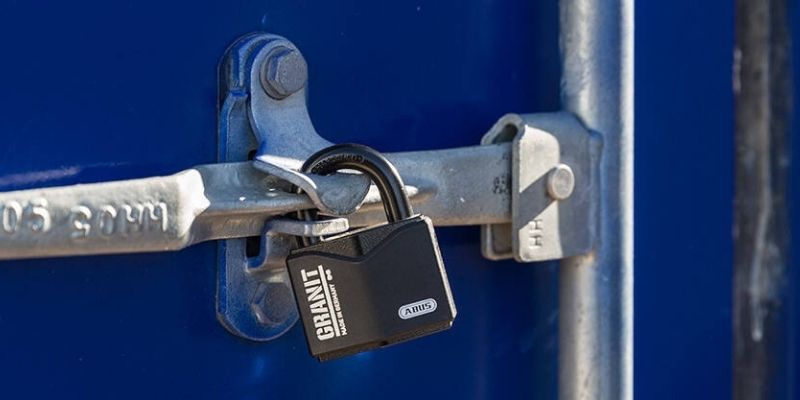
Not all padlocks are created equal — and the marketing language on packaging often obscures what actually matters for security. Here's what to evaluate before you buy.
Lock Body Design: Disc vs. Close-Shackle vs. Standard
The single most important physical feature of a storage padlock is how much exposed shackle it presents to a bolt cutter. Your lock body design determines your vulnerability to the most common attack method.
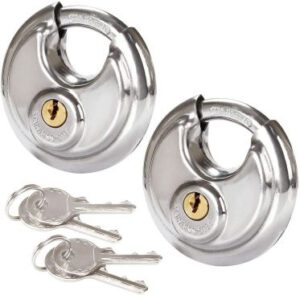
- Disc (Diskus) locks — Shackle is recessed inside the circular body. Bolt cutters cannot get a grip. Best for standard storage unit hasps. The ABUS 20/70 and 24IB/60 on this list use this design.
- Close-shackle locks — Shackle protrudes slightly above the body but is heavily protected by steel shrouds. Works for hasps where disc locks won't fit. The Abus 83/55 is the example here.
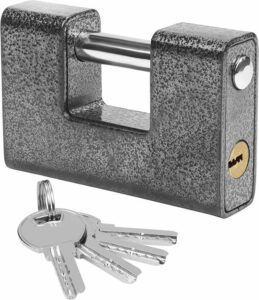
- Standard open-shackle locks — Traditional design with full shackle exposure. Compensate with boron steel shackles and thicker shackle diameters. The Master Lock 930DLHPF and BRINKS 50mm use this design.
Shackle Material and Diameter
The shackle is the most common point of attack after the cylinder. Material and diameter both matter:
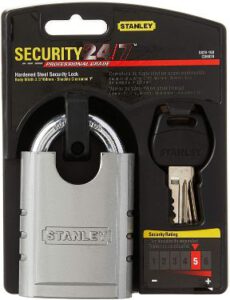
- Boron steel — Hardest common shackle material. Found in Master Lock and BRINKS options. Resists standard bolt cutters.
- Hardened alloy steel — ABUS Granit series. Excellent tensile resistance and cut resistance.
- Stainless steel — Corrosion-resistant, used in ABUS marine models. Good cut resistance, exceptional weather tolerance.
- Diameter — Bigger is harder to cut. For open-shackle locks, aim for at least 10mm (3/8") diameter for meaningful cut resistance. Disc locks compensate with geometry rather than diameter.
Cylinder Security: Pick Resistance and Drill Resistance
A cylinder that can be picked open in under a minute defeats the purpose of any lock body, no matter how robust. Evaluate cylinder security by pin count and mechanism type:
- 5-pin pin tumbler — Standard in Master Lock and BRINKS. Adequate for most storage use cases.
- ABUS Plus disc cylinder — Used in Granit series. Hardened against drilling, pick-resistant, anti-manipulation.
- Abloy rotating disc — The only mechanism on this list that is essentially unpickable through conventional techniques. Requires a completely different attack method that most thieves don't attempt.
- Drill protection — Look for hardened steel inserts in the cylinder housing. The ABUS Granit series specifically advertises this. Budget locks have no drill protection and can be defeated in seconds with a cordless drill.
Weather and Corrosion Resistance
A corroded lock is a defeated lock. If your unit is outdoor or in a humid climate, corrosion resistance directly affects your security, not just the lifespan of the lock.
- Indoor climate-controlled units — Any lock on this list is fine. Standard hardened steel holds up well.
- Outdoor drive-up units — Choose stainless steel (ABUS 24IB/60) or a lock with a protective body coating (ABUS Granit 37/70 RK, BRINKS TPE cover).
- Marine or coastal storage — Only the ABUS 24IB/60 with its full stainless steel construction is the correct choice. Salt air destroys standard steel finishes within months.
- Freeze-thaw climates — Look for cylinder lubrication compatibility and avoid locks with tight tolerances that may freeze in winter. The BRINKS ball-bearing mechanism handles cold temperatures particularly well.
According to the Wikipedia entry on padlocks, the most important security ratings for padlocks include ANSI/BHMA grades and European EN 12320 standards — look for these certifications when comparing commercial-grade options.
What People Ask
What type of padlock is best for a storage unit?
A disc-style padlock is the best choice for most storage units in 2026. The recessed shackle design makes bolt-cutter attacks extremely difficult, which is the most common real-world attack method against storage locks. The ABUS Diskus 20/70 is the top recommendation for standard storage unit hasps. If your hasp won't accept a disc lock, a close-shackle design like the Abus 83/55 is the next best option.
What size padlock do I need for a storage unit?
Most standard self-storage unit hasps accept a disc lock with 60–70mm body diameter and shackle clearances around 16–17mm horizontal and 13–17mm vertical. Measure your hasp before buying — the ABUS 20/70 at 70mm wide fits most standard hasps, while the 24IB/60 at 60mm wide suits slightly tighter hardware. When in doubt, bring your old lock's dimensions to compare against the new lock's specifications listed in the product details.
Can bolt cutters cut through a disc padlock?
Standard bolt cutters cannot effectively attack a quality disc padlock. The shackle is recessed inside the circular steel body, leaving no exposed shackle surface for the cutter jaws to grip. This is exactly why disc locks are recommended for storage units — the geometry defeats the most common tool used in storage unit theft. Heavy-duty bolt cutters can still attack the hasp or door hardware itself, which is a separate security consideration.
Is a combination padlock or a keyed padlock better for storage units?
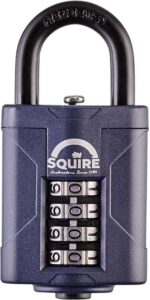
Keyed padlocks offer stronger security for storage units. Combination locks — even quality ones — are vulnerable to shimming and manipulation techniques that most keyed padlocks resist. For a storage unit you access regularly, a keyed disc padlock is the right choice. Combination locks make more sense for applications where losing the key is a serious problem, like gym lockers or school lockers with lighter security requirements.
How do I know if my storage unit padlock has been tampered with?
Look for scratches around the keyway, which indicate picking attempts. Check the shackle for saw marks or deep gouges from cutting tools. Inspect the body for drill marks near the cylinder housing. A lock that is suddenly difficult to open — when it used to open smoothly — may have been attacked and partially damaged. If you find these signs, replace the lock immediately and notify your storage facility manager. Understanding how padlock bypass works can help you recognize evidence of it — the guide on how to open a padlock without a key covers the common techniques that leave these telltale marks.
Should I use one padlock or two on my storage unit?
One quality disc padlock properly matched to your hasp is better than two cheap padlocks. The second lock only adds security if the hasp has two separate locking positions, both of different types — for example, a disc lock plus a close-shackle lock using different attack resistance profiles. For most standard storage units, invest in one excellent lock like the ABUS Diskus 20/70 rather than two budget options that are both vulnerable to the same attack methods.
Buy on Walmart
- ABUS - Diskus 20/70 Padlock with Key (2.75") 70mm - Heavy Du — Walmart Link
- Abloy Protec2 PL 321 Padlock — Walmart Link
- Master Lock 930DLHPF Padlock with Key, Hardened Steel — Walmart Link
- Abus 83/55 55mm Rock Hardened Steel Body Padlock Close Shack — Walmart Link
- ABUS 24IB/60 Diskus Storage Padlock with 2 Keys for Outdoor, — Walmart Link
- ABUS 37/70 RK Granit Alloy Steel Padlock, Keyed Different — Walmart Link
- BRINKS - 50mm Commercial Laminated Steel Keyed Padlock - Sol — Walmart Link
Buy on eBay
- ABUS - Diskus 20/70 Padlock with Key (2.75") 70mm - Heavy Du — eBay Link
- Abloy Protec2 PL 321 Padlock — eBay Link
- Master Lock 930DLHPF Padlock with Key, Hardened Steel — eBay Link
- Abus 83/55 55mm Rock Hardened Steel Body Padlock Close Shack — eBay Link
- ABUS 24IB/60 Diskus Storage Padlock with 2 Keys for Outdoor, — eBay Link
- ABUS 37/70 RK Granit Alloy Steel Padlock, Keyed Different — eBay Link
- BRINKS - 50mm Commercial Laminated Steel Keyed Padlock - Sol — eBay Link

Next Steps
- Measure your hasp before ordering — Check the horizontal and vertical clearance on your storage unit door hardware and compare it against the shackle clearance specs of your chosen lock. The ABUS 20/70 (17mm horizontal, 17mm vertical) fits most standard hasps, but non-standard hardware may need the 83/55 close-shackle instead.
- Check current prices on Amazon — Padlock prices shift regularly. The ABUS Diskus 20/70 and BRINKS 50mm in particular see frequent price changes. Click through to verify today's price before you decide between them.
- Match your lock to your environment — If your unit is outdoor, coastal, or exposed to significant moisture, go directly to the ABUS 24IB/60 for stainless steel weather protection. Don't pay the corrosion premium if your unit is climate-controlled indoors.
- Consider your total security layer — A great padlock is one piece of the picture. Pair it with a high-quality hasp (the hasp is often the weak link, not the lock), and consider whether a storage facility surveillance camera covers your unit aisle. Browse our camera reviews for options that complement physical lock security.
- Register your key card if applicable — If you purchase an Abloy Protec2 or ABUS Granit with key control features, register your lock and key card with the manufacturer immediately. This protects you against unauthorized key duplication and simplifies replacement if you ever lose a key.


About Vincent Foster
Greetings, This is Tom Vincent. I’m a home Security Expert and Web developer. I am a fan of technology, home security, entrepreneurship, and DIY. I’m also interested in web development and gardening. I always try to share my experience with my reader. Stay Connected and Keep Reading My Blog. Follow Me: Facebook, Twitter, Pinterest
Now you can get FREE Gifts. Or latest Free Security Cameras here.
Disable Ad block to reveal all the gifts. Once done, hit a button below