Security researchers estimate that more than 90% of padlock failures happen because the wrong lock type was chosen for the job — not because the lock was defective. Understanding padlock types and how to use each one correctly is the fastest, most affordable upgrade most people can make to their home security right now. Our team covers physical security in depth at SecureOne's padlock guides hub, and this topic consistently generates more questions than almost any other. Eight distinct padlock types exist, and each one is engineered for a specific environment and threat level.
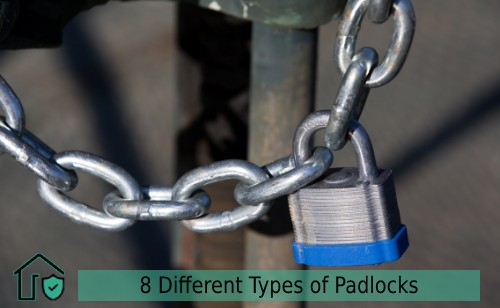
Padlocks are among the oldest portable security devices in existence, yet modern designs have evolved into highly specialized tools built to resist picking, shimming, and bolt cutters. Our team finds that most people treat padlocks as interchangeable — they grab whatever is cheapest at the hardware store and call it done. That approach leaves gaps that an opportunistic burglar can exploit in seconds.
In our experience, matching the padlock type to the environment and threat level is what separates effective security from false confidence. Here is our full breakdown of all eight types, with clear guidance on where each one fits best.
Contents
- Padlock Types and How to Use Each: Full Comparison Table
- Where Each Padlock Type Shines
- From Basic to High-Security: Beginner vs. Advanced Picks
- Five Quick Wins for Stronger Padlock Security
- Pro Tips for Getting the Most From Any Padlock
- Building a Lasting Physical Security Strategy
- Frequently Asked Questions
- Next Steps
Padlock Types and How to Use Each: Full Comparison Table
Before diving deep into each design, our team put together this quick-reference table covering all eight padlock types, their opening methods, security tier, and best-fit scenarios.
| Padlock Type | Opening Method | Security Level | Best For | Weatherproof? |
|---|---|---|---|---|
| Combination | Dial or push buttons | Low–Medium | School lockers, gym bags | Some models |
| Keyed (Open Shackle) | Key | Medium | Sheds, gates, general use | Yes (brass/steel) |
| Closed Shackle | Key | High | Shipping containers, storage | Yes |
| Disc / Round | Key | High | Chain gates, storage units | Yes |
| Straight Bar / Shackle | Key or combo | Medium–High | Gym lockers, outdoor cabinets | Yes |
| Locker Padlock | Key or combo | Low–Medium | School and gym lockers | No |
| Keyed-Alike | Same key for all locks | Medium | Multi-lock setups, fleets | Varies |
| Smart / Fingerprint | App, fingerprint, or PIN | Medium–High | Home gates, smart setups | Some models |
Where Each Padlock Type Shines
Keyed and Combination Padlocks
Keyed padlocks are the most common choice in residential settings. A hardened steel shackle loops through a hasp or chain, and a key releases the locking mechanism. Our team recommends these for sheds, garden gates, and garages where quick access and solid security are both priorities. Brass bodies suit dry indoor applications; hardened steel handles everything outdoors.
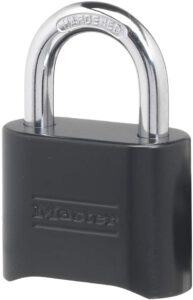
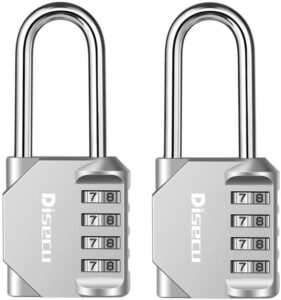
Combination padlocks eliminate keys entirely. Most people find them ideal for situations where keys get lost easily — gym lockers, bike racks, and travel luggage. The trade-off is real: a simple 3-digit combo can be cracked in under a minute. Our team strongly advises choosing 4-digit or directional combination models for anything beyond low-stakes use. If a combination is ever forgotten, our guide on how to open a padlock without a key covers the safe recovery methods.
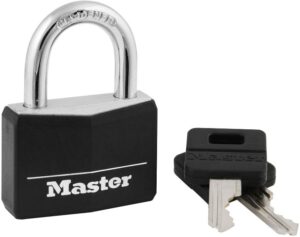
Locker padlocks are a subcategory built around slim, lightweight bodies sized for standard school and gym locker slots. They offer low to medium security — enough for personal belongings in supervised spaces, but not appropriate for outdoor or high-value applications.
High-Security and Specialty Designs
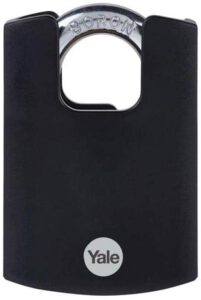
Closed shackle padlocks have a shackle almost entirely enclosed within the lock body. This design leaves very little exposed metal for bolt cutters to grip — a significant advantage over standard open-shackle designs. Our team recommends these for storage containers, high-value tool chests, and anywhere bolt cutter resistance is critical. For storage-specific guidance, our top padlocks for storage units guide covers the best closed shackle models available today.
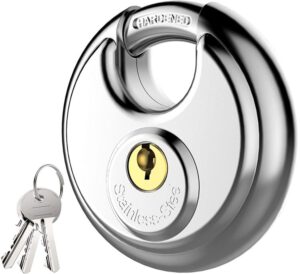
Disc or round padlocks feature a circular body with a deeply recessed shackle. Because the shackle barely protrudes, standard bolt cutters cannot find a clean angle of attack. These excel on chain-link gates and rolling shutter hasps. Our team considers the disc design one of the top two choices whenever home users ask about padlock types and how to use them for outdoor perimeter security.
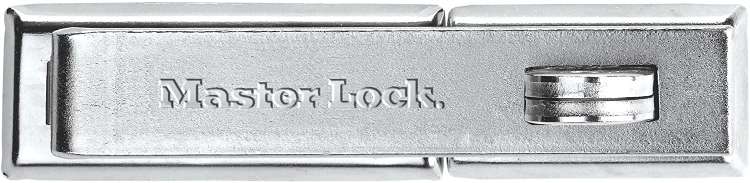
Straight bar padlocks — also called straight shackle padlocks — use a rigid bar instead of a curved shackle. They are purpose-built for sliding hasps and locker bars. Our team sees these frequently on gym lockers and outdoor equipment cabinets where a curved shackle simply will not fit the hardware.
Smart and Keyed-Alike Padlocks
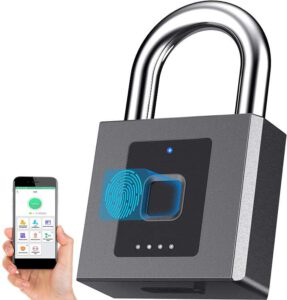
Smart padlocks open via Bluetooth app, fingerprint sensor, or PIN code. They are the newest entry in the padlock types lineup, and our team sees growing adoption among home users who want keyless access on side gates and storage areas without installing a full smart lock system. Fingerprint models in particular are popular because they eliminate both key management and memorized codes. Battery life is the main consideration — most models last six to twelve months on a charge.
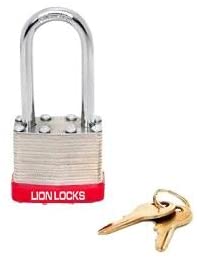
Keyed-alike padlocks are a set of multiple locks that all open with a single key. Homeowners securing several outbuildings, rental property managers, and anyone tired of carrying a heavy key ring will find these especially practical. The security level matches standard keyed padlocks — the benefit is purely operational convenience.
From Basic to High-Security: Beginner vs. Advanced Picks
Where Most People Start
Most people entering the world of padlocks reach for a standard open-shackle keyed padlock or a basic 4-digit combination model. These are appropriate for low-risk environments — a garden shed holding hand tools, a gym locker, a mailbox. Our team recommends brass bodies for dry indoor use and hardened steel for anything facing weather. For context on how padlocks fit alongside other home lock types, our overview of different types of door locks places everything in perspective.
Stepping Up to Serious Protection
For anyone securing high-value items, closed shackle and disc padlocks rated ANSI Grade 1 or equivalent are the benchmark our team uses. These locks resist picking, shimming, and bolt cutter attacks. Paired with a hardened steel chain or a heavy-duty hasp, they form a deterrent that most opportunistic thieves will walk past entirely. Smart padlocks are worth considering here too — they add access logging and remote management that purely mechanical locks cannot offer.
Five Quick Wins for Stronger Padlock Security
Our team compiled these steps that home users can apply immediately — no new hardware required for most of them:
- Match shackle clearance to the hasp. A long shackle on a thin hasp leaves exposed metal that bolt cutters can grab. A short or closed shackle removes that vulnerability.
- Check for weather ratings before outdoor placement. An unrated lock will seize or rust within one winter season in most climates.
- Spin the combination dial after locking. Leaving a combination lock resting on the last digit makes it trivial for anyone watching to learn the code.
- Use two locks on high-value gates. Two independent padlocks force an attacker to defeat both mechanisms — a strong deterrent at minimal cost.
- Replace locks older than five years on anything high-value. Internal springs and pins degrade over time, quietly reducing pick resistance without any visible sign.
Pro Tips for Getting the Most From Any Padlock
Pro tip from our team: Never secure a high-value asset with only one lock — use a disc padlock on the primary hasp and a secondary closed-shackle model on any chain, because defeating two different lock types simultaneously is a barrier most thieves will not attempt.
Beyond hardware selection, installation quality matters just as much as the lock itself. Our team sees preventable failures constantly. The most common: a Grade 1 padlock mounted on a flimsy hasp that pries off with a flathead screwdriver in seconds. The weakest link defines the entire system — a top-rated padlock on a poor hasp delivers the hasp's security rating, not the lock's.
- Lubricate keyed locks once or twice a year with graphite powder — oil attracts grit and gums up the cylinder over time.
- For combination locks, clean the dial mechanism annually, especially after outdoor exposure to rain or humidity.
- Store a spare key for every keyed padlock in a secure indoor location — not hidden outdoors near the lock itself.
- For smart padlocks, check battery level monthly; most models send low-battery alerts through the companion app before the lock stops responding.
Building a Lasting Physical Security Strategy
Understanding padlock types and how to use each one is the foundation, but a durable security strategy treats every lock as one layer in a larger system. Our team approaches physical security as a series of rings: the outer perimeter (fences, gates), the structure itself (doors, windows), and the interior (safes, cabinets). Padlocks serve primarily at the perimeter and structural layer — they are never the whole answer on their own.
Long-term, our experience shows that the most resilient home security setups combine high-grade padlocks with surveillance visibility. A camera pointed at a locked gate creates both a deterrent and an evidence record. A padlock without visibility is difficult to audit when something goes wrong.
- Audit all padlocks in use every 12 months — check for corrosion, shackle play, and smooth key operation.
- Upgrade any lock securing a space whose contents have grown in value since the lock was installed.
- Document serial numbers and reset codes for all locks, stored separately from the locks themselves.
- Consider a unified keyed-alike system for properties with multiple outbuildings to reduce key management burden without sacrificing security.
Physical locks and digital monitoring work better together than either does alone. Our team sees padlock security as an ongoing practice, not a one-time purchase decision.
Frequently Asked Questions
What are the most secure padlock types for outdoor use?
Closed shackle and disc (round) padlocks offer the strongest outdoor protection. Both designs limit shackle exposure, resisting bolt cutter attacks. Our team recommends pairing either type with a hardened steel chain rated to the same security grade as the lock body itself.
Can a combination padlock be as secure as a keyed padlock?
High-quality 4-digit or directional combination padlocks can match keyed padlocks at the medium-security tier. However, the highest security ratings consistently go to keyed models, since physical cylinders can incorporate pick-resistant spool pins and anti-shimming features that dial mechanisms cannot replicate.
What does "keyed alike" mean for padlocks?
Keyed-alike padlocks are a matched set where every lock in the group opens with the same key. Our team recommends these for homeowners or property managers who need to secure multiple access points without carrying a separate key for each one.
Are smart padlocks weatherproof?
It depends on the model. Most smart padlocks carry an IP65 or IP66 rating, meaning they handle rain and dust but should not be submerged. Our team advises checking the specific IP rating before purchasing any smart or fingerprint padlock for outdoor gate or shed use.
How does a fingerprint padlock work?
A fingerprint padlock uses a small biometric sensor built into the lock body. Registered fingerprints are stored locally on the device itself, not in a cloud database. When a recognized print is detected, a small motor releases the shackle. Most models also include a backup PIN or physical key for emergencies.
What is a disc padlock and why is it harder to cut?
A disc padlock has a circular hardened steel body with the shackle recessed almost entirely inside it. Because so little shackle protrudes, bolt cutters cannot achieve the leverage needed to snap it. This makes disc padlocks one of the most bolt-cutter-resistant designs available at a reasonable price point.
How often should padlocks be replaced?
Our team recommends replacing padlocks every five to seven years for high-security applications, or sooner if corrosion, shackle play, or sluggish key operation is detected. Locks on lower-value assets can go longer, but an annual hands-on inspection is still a sound practice regardless of age.
Next Steps
- Walk through all padlocks currently in use and flag any with corrosion, shackle wobble, or stiff key operation — these need immediate replacement.
- Replace any outdoor open-shackle lock securing a high-value space with a closed shackle or disc padlock; this is the single highest-impact hardware upgrade most people can make today.
- Inspect every hasp and mounting plate — upgrade any that can be pried off without tools, since the lock is only as strong as what it is bolted to.
- If managing multiple access points, evaluate a keyed-alike padlock system to simplify daily operations without reducing security.
- Pair any upgraded padlock installation with a camera covering the access point — visibility amplifies the deterrent effect of even a basic lock and creates an evidence record if an incident occurs.


About Vincent Foster
Greetings, This is Tom Vincent. I’m a home Security Expert and Web developer. I am a fan of technology, home security, entrepreneurship, and DIY. I’m also interested in web development and gardening. I always try to share my experience with my reader. Stay Connected and Keep Reading My Blog. Follow Me: Facebook, Twitter, Pinterest
Now you can get FREE Gifts. Or latest Free Security Cameras here.
Disable Ad block to reveal all the gifts. Once done, hit a button below