If you're searching for the best spring door stoppers 2023, here's the direct answer: a 3-inch steel spring stopper with a rubber tip, mounted at baseboard height, is the most reliable choice for residential doorways. These small but essential pieces of door hardware prevent wall damage, protect door trim, and extend hinge life without any daily maintenance required on your part.
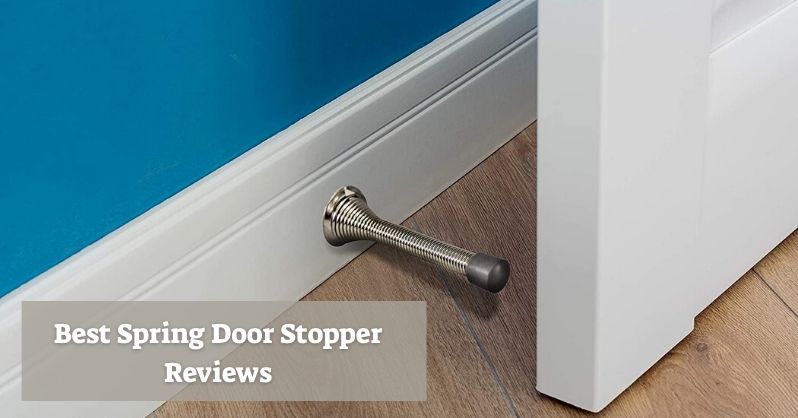
Spring door stoppers work by absorbing the kinetic energy of a swinging door through a flexible coil that compresses on impact and then returns to position without any manual reset. Unlike wedge-style stops or magnetic catches, they're fully passive and self-resetting, which makes them ideal for high-traffic doorways where doors get pushed open dozens of times each day. The spring's flexibility is precisely what prevents the tip from gouging drywall when someone opens a door with too much force.
The five products reviewed here — Jack N' Drill, HOMOTEK, HouseHold Impressions, Design House, and KOVOSCH — cover the full range from budget multi-packs to premium single units, evaluated on spring tension consistency, tip material, corrosion resistance, and installation ease. If you've ever worked through common door hardware failures, you already know how one failing component creates a chain of secondary issues throughout the whole door assembly.
Contents
What Spring Door Stoppers Actually Do
The Mechanics Behind the Coil
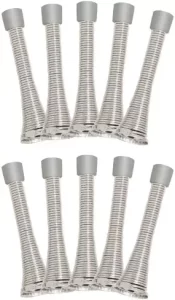
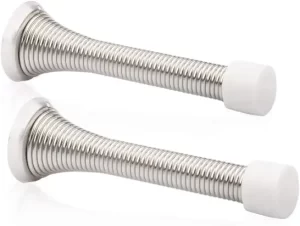
A spring door stopper has three primary components: a threaded steel shank, a coiled spring body, and a rubber or vinyl tip. The rubber tip is where almost all of the protective work happens — it's the only part making direct contact with your door, and a cracked or hardened tip transfers force straight to the steel shaft, which then scores your door finish or punches into drywall. When evaluating any stopper, check tip hardness and diameter before anything else, because a tip that's too small concentrates impact force instead of distributing it across a broader contact surface.
The coil itself matters for a separate reason: a spring that's too stiff pushes the door back rather than absorbing the impact, while one that's too soft collapses completely and lets the door overshoot the stopper's effective range. Quality spring stoppers use tempered steel calibrated for 15 to 35 degrees of deflection — enough to handle the full range of normal residential door impact without bottoming out against the shank.
According to the U.S. Consumer Product Safety Commission, preventable hardware failures account for a significant portion of household property damage reports, and most are correctable with properly specified components installed at the right position.
Why This Connects to Home Security
You might wonder why a home security blog covers something as basic as a door stopper. The answer is structural: a door that repeatedly impacts its own frame damages the wood, the strike plate, and the hinge mortises over time, making forced entry measurably easier. Burglar-proofing your home begins with hardware that's physically intact, and a frame weakened by years of impact damage compromises even a high-quality lock. Installing proper stoppers belongs to the same discipline as installing a deadbolt correctly — it preserves the structural integrity that your lock depends on to function.
Comparing the Best Spring Door Stoppers 2023
Side-by-Side Specs
| Product | Pack Size | Length | Finish | Tip Material | Best For |
|---|---|---|---|---|---|
| Jack N' Drill | 15-pack | 3.1 in | Satin Nickel | Rubber | Whole-home installs |
| HOMOTEK | 12-pack | 3.0 in | Brushed Satin Nickel | Rubber | Multi-room value |
| HouseHold Impressions | 12-pack | 3.125 in | Satin Nickel | Heavy-duty rubber | Heavy solid-core doors |
| Design House 181701 | Single | 3.5 in | Satin Nickel | Vinyl | Premium visible entryways |
| KOVOSCH | 2-pack | 3.0 in | Brushed Satin Nickel | Rubber | Targeted replacements |
Which One Fits Your Situation
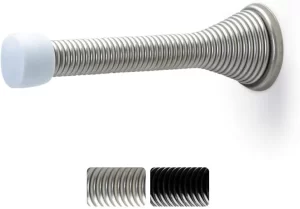
The Jack N' Drill 15-pack is the clear pick for anyone outfitting an entire house — the per-unit cost drops significantly compared to smaller packs, the 3.1-inch length handles standard interior doors cleanly, and the satin nickel finish matches most modern hardware. If you're replacing hardware after a project like replacing a front door, buying in bulk prevents a separate follow-up order for all the interior rooms at once.
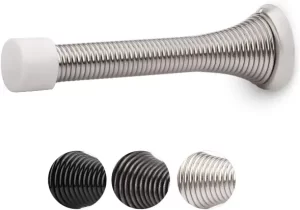
The HouseHold Impressions 12-pack is the right choice for heavier solid-core or fire doors — the 3.125-inch length and heavier-duty rubber tip absorb greater impact force without the tip deforming under load. The KOVOSCH 2-pack suits targeted replacements in high-traffic spots where an existing stopper failed early, while the Design House 181701 earns its premium price in visible areas like an entryway where finish quality and profile actually matter to the overall look.
Getting Installation Right
Baseboard vs. Floor Mounting
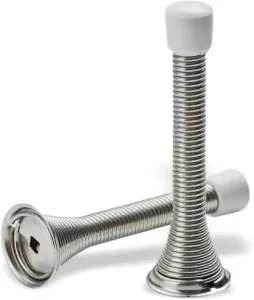
Spring door stoppers mount either to the baseboard or to the floor, and your flooring type determines which is more secure. Baseboard-mounted stoppers are generally more reliable in homes with hardwood or tile floors because they anchor into the baseboard and potentially the stud behind it, giving a solid mechanical connection that a floor screw set into grout or floating laminate simply cannot match. Floor mounting works well on concrete subfloors and in commercial settings where baseboards are absent or too thin to hold a shank reliably under repeated lateral stress.
If you're also planning to add a closer to the same door, read through how to install a door closer before committing to stopper positions — the closer's swing arc changes where the door naturally decelerates, which directly affects your optimal stopper placement angle.
Measuring the Correct Position
Open the door to its maximum intended swing, mark where the door edge falls, then position the stopper so it contacts the door roughly two inches before that maximum point. This buffer prevents the door from slamming through the stopper's deflection range on a hard push. Drive the shank into a stud where possible, or use a rated toggle bolt in drywall — a single unanchored drywall screw provides almost no shear resistance and will loosen within weeks in an active doorway.
Pro tip: Before drilling, hold the stopper in position and press the door against it by hand — if the spring bottoms out completely before the door stops moving, you need either a longer stopper or a different mounting position closer to the door's travel path.
What Most People Believe That Isn't True
The "Any Cheap Stopper Works" Myth
The most widespread misconception is that all spring door stoppers are essentially the same product and that paying more than a few dollars each is wasteful. In practice, the difference shows up within the first six months: the rubber tip hardens and cracks in temperature-variable rooms, the shank threads strip on the first installation attempt, or the spring loses tension after repeated compression cycles. A stopper that fails means unprotected impacts every time someone opens that door, and repeated unprotected impacts cause cumulative frame damage that costs far more to repair than a quality stopper would have cost upfront.
Understanding how door hardware works mechanically gives you better intuition for why material quality matters throughout the whole system, not just for locks and handles.
Spring Tension Doesn't Matter — Wrong
Some buyers focus entirely on tip material and ignore spring tension, which creates two simultaneous problems: a spring that's too stiff bounces the door back toward the person opening it, and one that's too soft collapses and allows the door to travel past the stopper into the wall. All five products reviewed here use tension calibrated for standard residential doors weighing 30 to 80 pounds — but if you have unusually heavy solid-core or steel-clad doors, confirm the manufacturer's rated load capacity before purchasing to avoid this problem entirely.
Installation Errors That Cost You
Wrong Mounting Height and Angle
Mounting a baseboard stopper too high places the contact point near the door's center of mass rather than near its bottom edge, which means the stopping force creates rotational torque on the door instead of a clean linear stop — straining the hinges on every single impact. The correct height is one to three inches above floor level, making contact with the bottom rail where the door's wood is thickest and most impact-resistant. If you've ever dealt with a door lock that's gradually stopped functioning correctly, repeated hinge strain from a mispositioned stopper is one of the underappreciated indirect causes behind that kind of mechanical drift.
Skipping the Drywall Anchor
The single most common installation mistake is driving the stopper shank straight into drywall without an anchor, relying on the thread alone to hold against lateral forces. Drywall provides almost no shear resistance — the stopper loosens within weeks in an active doorway, and once the hole strips out, you'll need to patch and relocate rather than simply retighten. Use a toggle bolt or a hollow-wall anchor rated for at least 50 pounds of lateral load whenever you can't hit a stud directly behind the baseboard.
Keeping Your Stoppers Working Long-Term
Cleaning and Inspection
Spring door stoppers require minimal maintenance, but a quick inspection twice a year prevents the slow-failure mode you won't notice until a door punches through drywall. Check the rubber tip for cracking, hardening, or compression set — a tip that no longer springs back to its original dome shape after compression has lost its protective value entirely. Wipe the spring coil with a dry cloth to remove dust accumulation that traps moisture against the steel, and confirm the shank is still threaded firmly without any perceptible play when you push the spring laterally by hand.
When to Replace
Replace a spring stopper when the tip is cracked or permanently flattened, when the spring no longer returns to vertical after deflection, or when the mount shows visible movement as the door contacts it. A loose or damaged stopper provides zero protection and should be swapped out immediately rather than left in place as a false reassurance. All five products reviewed here come in multi-packs specifically because replacement is a routine part of home hardware maintenance — keeping spares on hand turns it into a five-minute fix instead of a hardware store trip.
Frequently Asked Questions
What is the best length for a spring door stopper?
For most standard interior residential doors, a 3-inch to 3.5-inch spring stopper is the correct length. Shorter stoppers can bottom out under hard impacts, while longer ones angle the door contact point too far from the wall and reduce stopping effectiveness. All five products in this review fall within that optimal range for typical residential use.
Can I install a spring door stopper on a tile floor?
Yes, but you need a masonry drill bit and a proper anchor rated for tile and concrete substrate. Avoid driving a screw directly into grout lines, which will crack and loosen under repeated lateral stress. The anchor should be set into the tile body itself, sized for at least 50 pounds of shear load to handle door impact forces reliably.
How do I stop my spring door stopper from squeaking?
Squeaking comes from the spring coil rubbing against the shank during compression. Apply a small amount of silicone-based lubricant to the coil — not a petroleum-based product, which attracts dust and gums up the spring over time. This eliminates the noise without affecting spring performance, tip integrity, or the stopper's finish appearance.
Are spring door stoppers better than magnetic door stoppers?
For wall protection, spring stoppers are more reliable because they work passively on every door swing without depending on a magnet to engage correctly. Magnetic stoppers excel at holding doors open in a fixed position, but they provide no impact absorption — if someone pushes the door without engaging the magnet, there's no protection at all. The two types solve different problems and are best evaluated separately based on what your doorway actually needs.
Final Thoughts
Spring door stoppers are one of the highest-value-per-dollar upgrades you can make to your home's door hardware, and the five products reviewed here give you a clear path from budget multi-pack installs to premium single-door solutions. Pick the option that matches your door weight and mounting surface, install it at the correct height with a proper anchor, and inspect it twice a year — that's the complete maintenance requirement. Head to our door hardware section to explore the other components that keep your doors and frames structurally sound for the long term.


About Vincent Foster
Greetings, This is Tom Vincent. I’m a home Security Expert and Web developer. I am a fan of technology, home security, entrepreneurship, and DIY. I’m also interested in web development and gardening. I always try to share my experience with my reader. Stay Connected and Keep Reading My Blog. Follow Me: Facebook, Twitter, Pinterest
Now you can get FREE Gifts. Or latest Free Security Cameras here.
Disable Ad block to reveal all the gifts. Once done, hit a button below